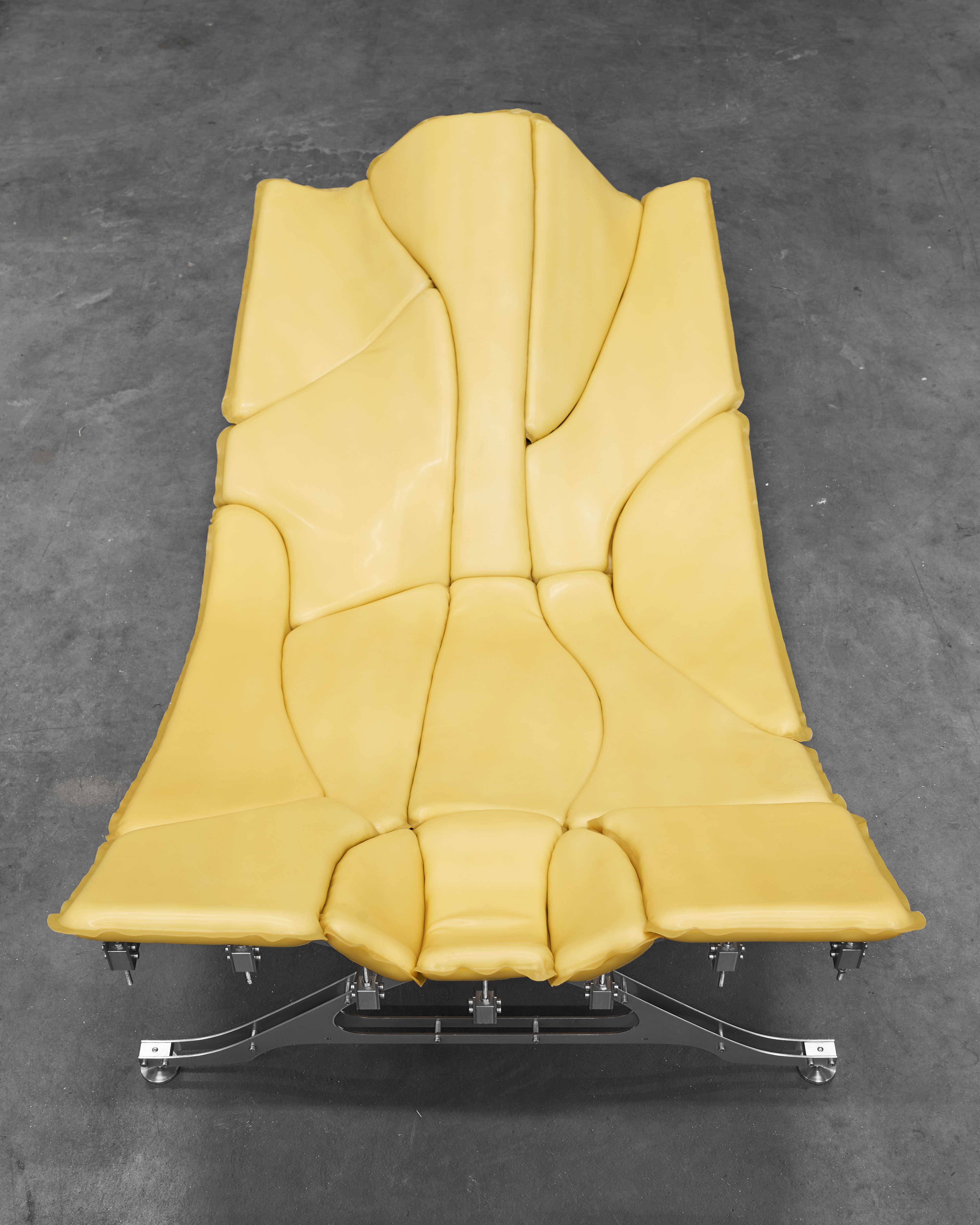
Daydreamer
Daydreamer started from something ordinary: the way you sometimes lie down on the floor. Not exactly because you're tired. More because lying down interrupts everything. Your phone goes face-down, your posture stops being a performance, and suddenly you can feel your own body again. We wanted to build that moment into a piece of furniture.
The chair lifts you a few centimetres off the ground, close enough that the floor is still part of the experience, and puts you somewhere between sitting and lying. Its surface is split into asymmetric segments, one for the head, one for each arm, one for the legs, one for the torso, and the gaps between them keep the body parts apart. Nothing holds you all at once. You notice each part individually, the way attention moves through the body in yoga nidra, a practice where you recline still and let your awareness travel from limb to limb.
We made it for the first Rotterdam Design Biennale, whose theme was What's Real is Unfamiliar. Our reading of that was simple: an unfamiliar posture can reveal something true about your body. As we put it then, the seemingly unfamiliar turns out to disclose the real and the true. Daydreamer isn't just furniture, it's an invitation to non-performance, to self-observation instead of scanning the world.
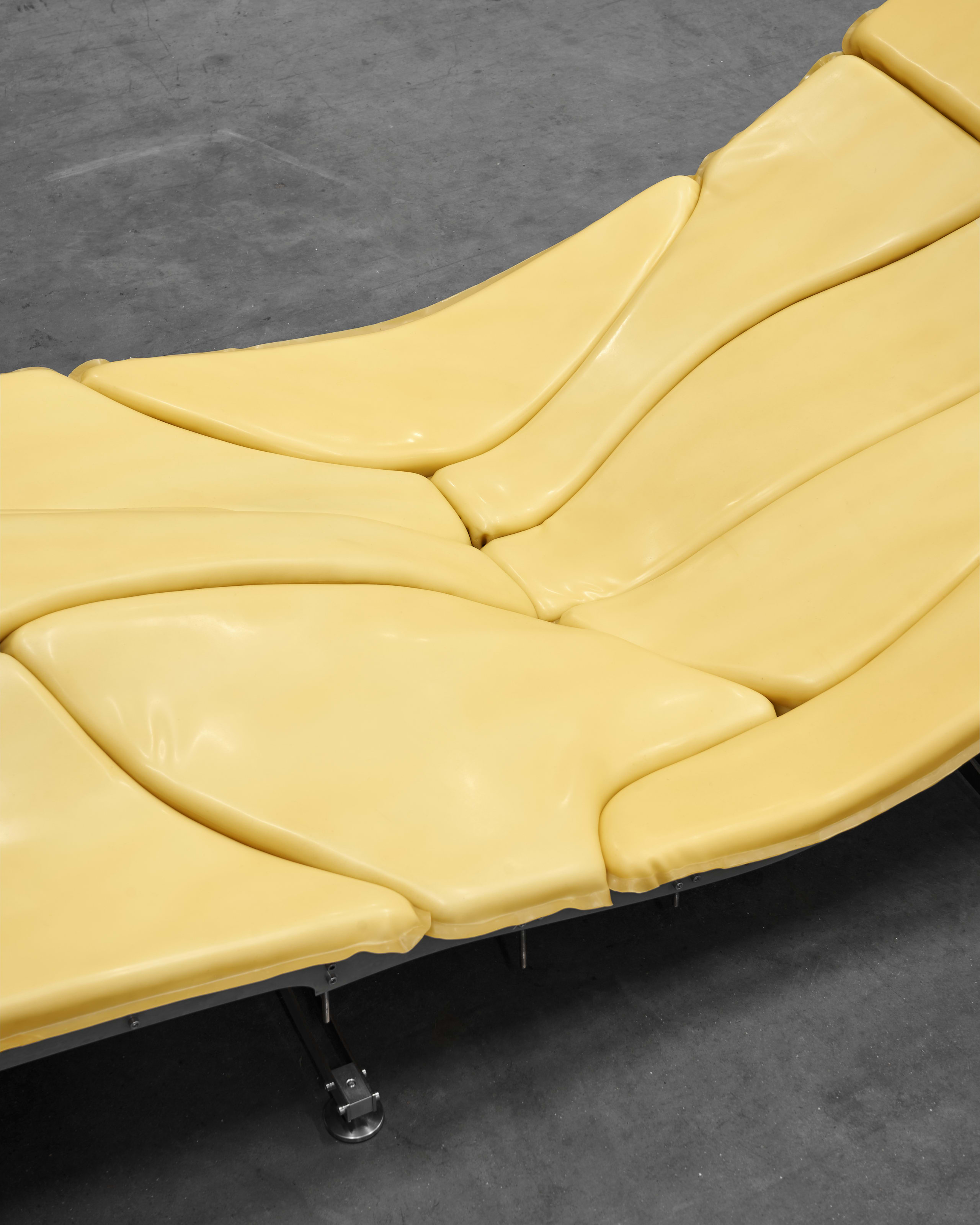


We had never worked with latex before, and that turned out to be the interesting half of the project. The surface is natural latex, a plant material tapped from Hevea trees. The trees aren't cut down, they're harvested several times a year, and the process is carbon-negative. That made it a genuine alternative to animal-derived materials and plastic, which felt important to us.
Getting it right meant working with people who know latex far better than we do. The company ALMOTEX spent time explaining how the material behaves, what it wants to do, where it resists. We left the surface in its natural colour rather than dyeing it, because the material already reads as skin, and the translucency does the rest. The upholstered shapes echo muscle groups; the steel below echoes bone.
The frame is foldable stainless steel, eight thin legs, a spine that carries the soft top. It's the part of the chair that's honest engineering, precision you can't see. The rest is meant to be felt.
There's a contradiction we didn't try to hide: the silhouette leans forward, references the aesthetics of performance products, suggests motion. The function is complete stillness. We liked that tension.


The chair debuted at the Rotterdam Design Biennale in February, the first edition of a design biennale in the city, with over a hundred designers from around the world. From there it moved to Brussels for COLLECTIBLE in March, in a group show curated by Spazio Viruly. It has since been shown at Spazio Viruly's group exhibition back in Rotterdam and at Maison&Objet Intérieurs in Hong Kong.
Four venues in a few months, each with a different audience, and each time the same reaction: people sit down and go quiet. That's the whole point, and we're glad it travels.
It was our first piece in latex, and it continues the way we usually work: taking observations from fashion, photography, contemporary art and turning them into something spatial. What we took away from the process is that latex has a temper of its own, and it's worth learning that temper before you design around it.